
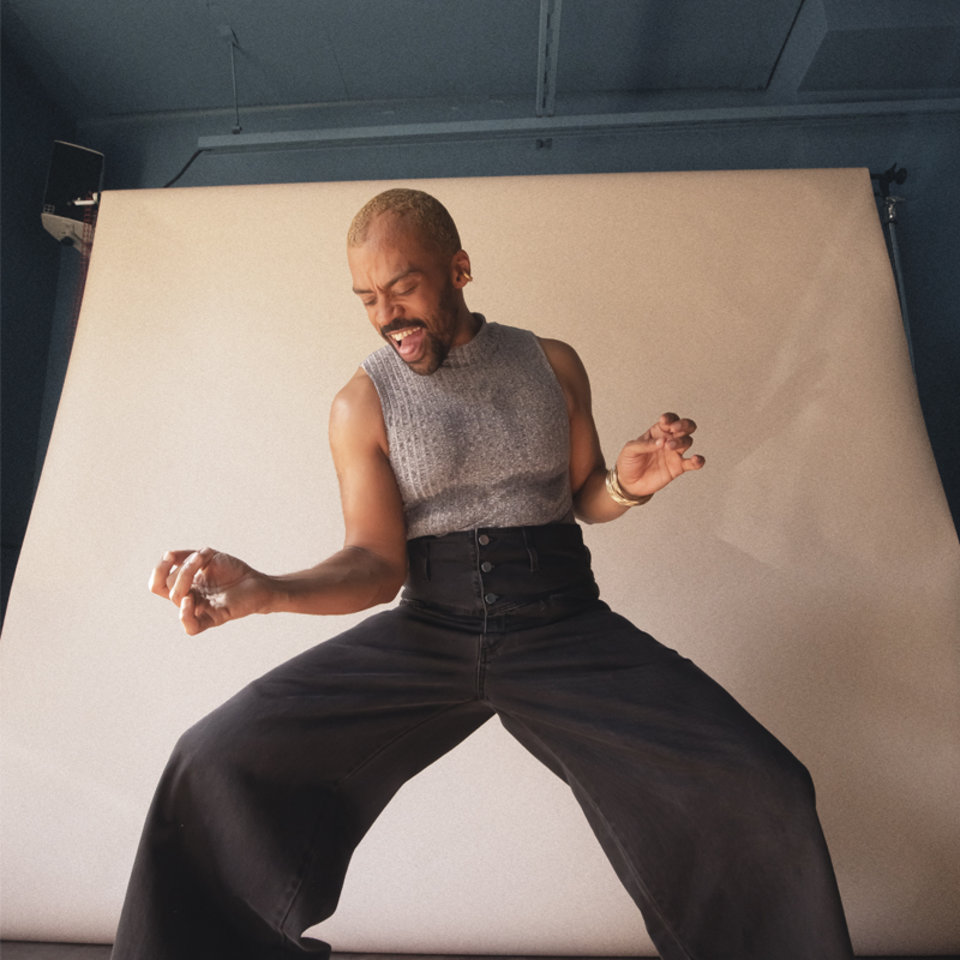
“I was moving the body the way it was natural for me, just me, without a gender conception” - Interview with Jani Toivola
When I was searching for your work, I came across a video interview called I’ve Found the Performer in Me, where you shared a moving story of how you decided to perform in your school and ended up receiving negative comments from your colleagues. Yet, you decided to stay on stage and keep dancing. Back then, what was the reason why you kept performing?
Jani: Well, I think I have to start first with the reason why I decided to get up on stage. For me it was quite natural: dance and acting were already a big part of my persona and my story. So, in a very naive way, I thought that performing was great to express myself in a new school, and a way to make new friends and be accepted. It was a very pure idea, without any traces of shame or fear - even though it could somehow go wrong! And the reason why I'm sharing that is that I’m still revisiting that moment often, feeling I’m again that young person so connected with my core. There were no different layers created when you think about the consequences, or what people might think, or what are the rules - because even professional artists are so many times blocked by those different kinds of rules and expectations about what we think art is. So, for me, it’s very important to remember who I was when I was thirteen when things were very simple and childlike, but at the same time with a big desire to tell my story and be on stage.
Back to that episode at school… I went to that new place and new community. And I started practising my performance, I chose my clothes and the music, I was very excited. Then the day came and I went on stage. Of course, I was nervous, I wanted to do well, to remember the choreography… Everything was starting well but at some point, I started to hear the crowd - hundreds of teenage kids - yelling and saying I should get out of there and some offensive words about my identity and how I looked. My first reaction was a huge panic and a need to run out of the stage, go home and call my mom to tell her that we needed to move to another city. I was feeling like I was in the worst moment of my life. But then, somehow, I just felt a really strong energy and a need to stay on stage. I just saw myself continuing dancing and, all of a sudden, the more I was hearing the screaming from the audience, the stronger I was feeling about my identity and who I wanted to be as an artist. I don’t know what happened exactly at that moment, but it showed me the core part of myself that I wasn’t willing to negotiate or give up. That episode was the first time I recognized what was my core passion, after going through the fear. And I don’t think there is anything more powerful than experiencing your own core, feeling you are above everything else - fear, shame. That was why I kept dancing on that stage.
After the performance, I remember that some kids came to me, excited. And I felt I have found peers. The lesson I got from that day was that every time you show who you are, you can find your allies, your community. And if you don’t do that, it’s much harder to find those people.
Back in those days, did you feel that movement and dance help you discover your identity?
Jani: Most definitely! It was hard being black and growing up in Finland, in a dominantly white country. It was very hard to find those mirrors able to show you who you are, or people I could relate to. So, I think as an individual I started soon exploring what worked for me. Who I am, where do I want to go, what does it mean to be a black person in Finland? Or what does it mean to be a young gay boy? I feel very lucky that I found arts and dance so early, as they were tools for me in a very turbulent time when you’re figuring out where I felt accepted, felt loved, where there was room for me to grow, experience and explore. And the stage has been a place allowing me to discover all of this. When I was growing up, I felt that the rules were very strict on how a young man is allowed to move. The picture was that men are not sensitive in terms of their bodies, that they are strong, lift things or destroy others. Or rather, because you’re a man, you don’t have a connection with your body. I think about this issue a lot on stage, when I’m exploring male identity and how the male body looks.
Also, culturally, there is a constant fear that you might look too feminine, which makes you overthink about the way you keep your hands, or if you cross your legs when sitting down… And dance on stage can be the opposite. I was moving the body the way it was natural for me, just me, without a gender conception.
And then you decided to move to New York to study acting. Did that experience change your life?
Jani: That’s a very big question. It was a big turning point in my life. I was twenty, coming from Finland, which is a small, white-dominated country, where I didn’t have any stories to relate to in terms of loving myself as black and gay. When I landed in New York, I started seeing black people everywhere, in different ages and styles and different positions of society. As an artist, that was a big thing, as it was the first time in my life I saw other people who looked like me on stage, whether it was acting or dancing and recognizing elements of movement that I carried with me, but I had never seen in the Nordic countries, where the dance was more normative and strict. Going to New York allowed me to realize that moving can be many different things, apart from roles, styles or genres.
Of course, moving there was also important for my identity. It was the first time I saw two men holding hands on the street, or seeing an indie romantic comedy with two men playing the lead roles. Or seeing families where there were two fathers with children - gay men, loving each other, having a family. Until that point, I had thought that I had to choose between being gay or becoming a parent. Seeing these people released me from all that shame and fear and allowed me to also picture myself in that life.
Who were you when you moved back to Finland?
Jani: When I came back to Finland, I still couldn’t find those pictures and cultures I had experienced in New York. But I noticed that something had changed in me, like if I had been into the future and returned to the present stronger, aware that change was possible because it was already existing somewhere else, which gave much more sort of room in Finland to be myself and to manifest the life and work I wanted to do as an artist. Even today, I feel that I still have a strong connection with that time in New York. And if I didn’t move there, I couldn’t be the artist I am right now. That experience became a part of me, part of my work and it helped me break the unnecessary rules or ways of thinking that limits what art is.
You ended up becoming the first-ever black member of the parliament in Finland, in 2011. When you first jumped into politics, what were the conversations you were keen to bring up?
Jani: It was never my plan to become a politician or an MP. I wanted to be an artist, and that’s what I did. But then, more and more conversations appeared in Finland about human rights, equality and inclusivity, especially regarding same-sex marriage, gay rights and trans rights. All the elements that were closer to my heart. So I just started to be part of the conversation. By that time, I became a public person, so my opinions became more public, and people started to react to it in a very positive way. That was how I ended up becoming a candidate for the Green League party and then elected. It was all so strange because I felt that everything changed in one day - the day before, you are an artist, performer, your individual. And then, it's election night and the next morning you wake up and you are a politician, you carry the whole story of politics on your shoulders. Suddenly, I felt I was back in that school when I was thirteen. When we had those strict rules. I went to the parliament and I felt the same kind of norms, pressure and not knowing anymore how to act from your core while trying to adapt yourself to the image of a politician. It was a big change.
My priorities when I started working as an MP were human rights, equality and LGBTIQA+I issues. I worked quite a lot with the school system and young people. But my number one goal was to try to reach equal rights for marriage, which happily happened. We got same-sex marriage approved in the parliament.
Ten years later, where are we in terms of minorities in society? What are the wins and the challenges for the future?
Jani: In ten years, I think we reached quite a lot. There are more conversations about different identities and issues such as racism or equal rights. But I still feel we have very poor legislation concerning trans people’s rights - and not only here in Finland. It seems that things are not moving anywhere, which is a big concern. When you talk about trans rights, it’s so easy to see it as a minority issue - it’s a small group of people who have to deal with this problem. And when it’s a small group, it’s easier to lose their voices in other people's opinions. How often do we lose the ability to listen to their needs? Instead, it becomes about our opinions. However, we should be thinking about stronger ways to listen to other people and move in the direction they need.
You have found multiple ways of expressing yourself, such as writing, hosting and performing. What is the core of your work? What’s your main mission?
Jani: For me, different forms of art are like different tools to try to answer the same questions. I feel that I’m using the same core, but I just changed the tools. Sometimes I write, other times I act. Sometimes I use my body and I need to move or combine everything. I’m also very interested in film.
But what the core is… I think it’s about finding a connection between myself and others, about trying to create a space where people can hear themselves or listen to a community with different stories and experiences about life. This is the way I found to share a piece of my story - I show my vulnerability through my art. At the same time, I try to reach new people all the time; I’m curious about having a diverse audience, which challenges me as an artist. When you have a certain kind of audience, and you get used to a certain kind of dialogue, you get approval to a certain way of being on stage. But then, somebody from the outside comes to your show and doesn’t understand. I don’t want to be in that closed space, but asking the tough questions instead. As artists, we need to be careful that we don’t sort of go into the principle that we don’t need to change or evolve. We need to keep asking: What’s wrong in our field? What do we need to change? Is it accessible to everybody? Do we need to define who can be an artist? Those power structures are separating artists and people to find new things. That was why I launched a campaign to support my upcoming performance on Eventual. In these kinds of platforms, there are no gatekeepers, these traditional decision-makers believe they know what people want to experience. But when we allow something new to happen, we understand what the audience wants from us. That challenges both artists and audiences to be curious in a new way, to have the courage to try new things.
You are now working on a performance called About Love. Can you tell us more about the concept?
Jani: This new performance is based on my book that came out last Spring, which has the same name. The book combines stories about my life, and they are all connected to love and the experience of love in a male body’s experience. The performance works around the same topic - How does it feel to live inside of a man’s body? What does it mean for a man to love his body? Or what does it mean for a man to love another man? About Love is about my relationship with myself, but also my relationship with other people, as a man.
I think that we still look at the male body so often without a story behind it - just as a figure holding power or standing. But where is the sensitivity? Where are the different experiences carried by that body? When I talk about my relationship with other men, it’s not only romantic but also as friendship - I’m very interested in exploring this idea of existing rules in male friendships; specifically when we talk about the body: are we allowed to be tender? Can we touch each other? Can we hold each other in our arms? I will be diving into this idea of finding new forms of affection in male relationships.
Jani Toivola launched a successful campaign on Eventual to produce his newest performance, About Love. You can still get tickets for both performances taking place at G Live Lab, on the 9th and 16th of March. You can discover more here.
Keep reading
All stories
Behind the Party: Sex Tales & Cocktails
Sex Tales & Cocktails | Helsinki | Disco We take a look behind the party with the Sex Tales & Cocktails organizers Hitoshi Omori & Justus Arvelin.
Read · 2 min
Reset the City: Berlin with Axel Hjertman
There’s inspiration in every corner of Berlin and events for everyone. Bold club nights, gallery exhibitions, or street performances: this is a city for creativity. We asked DJ and producer Axel Hjertman what are the unmissable places and things to do in Berlin. Take your notes and make your next trip to Germany’s capital unforgettable.
Read · 2 min
Reset the City: Beirut with Reem Naamani
We asked dance artist Reem Naamani to describe Beirut's cultural scene. From the traditional buildings to a new generation of artists, Lebanon is an inspiring place for Reem - and you can discover why on this new Reset the City episode.
Read · 1 min